



Source Water Algae Improves at Berthoud, Colorado
Background
The Town of Berthoud, Colorado operates a surface water treatment system supplied by the Berthoud Reservoir. This consists of two distinct cells, the East Cell and the West Cell. The reservoir spans more than 30 acres, making source water algae management a critical operational consideration. Like many utilities in the region, Berthoud has historically faced seasonal algae growth during warmer months. Leading to elevated levels of taste and odor compounds such as geosmin and MIB (2-Methylisoborneol).
Taste and odor events have traditionally increased the use of Powdered Activated Carbon (PAC), particularly during the summer season. This is due to higher water production demands that coincide with increased algal activity. To improve source water quality and reduce treatment challenges associated with source water algae, Berthoud sought an upstream approach focused on algae control and real-time monitoring.
To support this goal, the Town of Berthoud installed the MPC-Buoy technology in the reservoir, targeting algae growth and improving raw water conditions prior to the treatment.


Project Summary
Reduced Taste & Odor Intensity
During the summer of 2025, Berthoud experienced fewer intense taste and odor issues between July and early September compared to the previous year.
Improved Algae Conditions at the Source
Noticeably less floating algae was observed in the East Cell since the installation of the buoy systems.
Operational Insight Through Monitoring
Continuous real-time data from MPC-View supported better planning and anticipation of treatment needs.
The Problem
1. Seasonal Taste and Odor Events
During summer months, increased algal activity in the reservoir led to elevated geosmin and MIB (2-Methylisoborneol)concentrations entering the treatment plant. This required higher PAC dosages during peak season, creating operational variability and increased chemical dependency.
2. Algae Variability Between Reservoir Cells
The Berthoud Reservoir consists of an East and West Cell, which behave differently throughout the season. Historically, the West Cell exhibited more visible floating algae during summer, while the East Cell directly supplied water to the treatment process. Managing algae growth upstream was critical to improving consistency in raw water quality.
3. Limited Predictive Insight
Prior to continuous monitoring, treatment decisions relied heavily on lab data and visual observations. This had limited the ability to anticipate changes in reservoir conditions in real time.
Measurable Results
Since deploying LG Sonic technology, Berthoud has observed several operational and water quality improvements, particularly during the 2025 season.
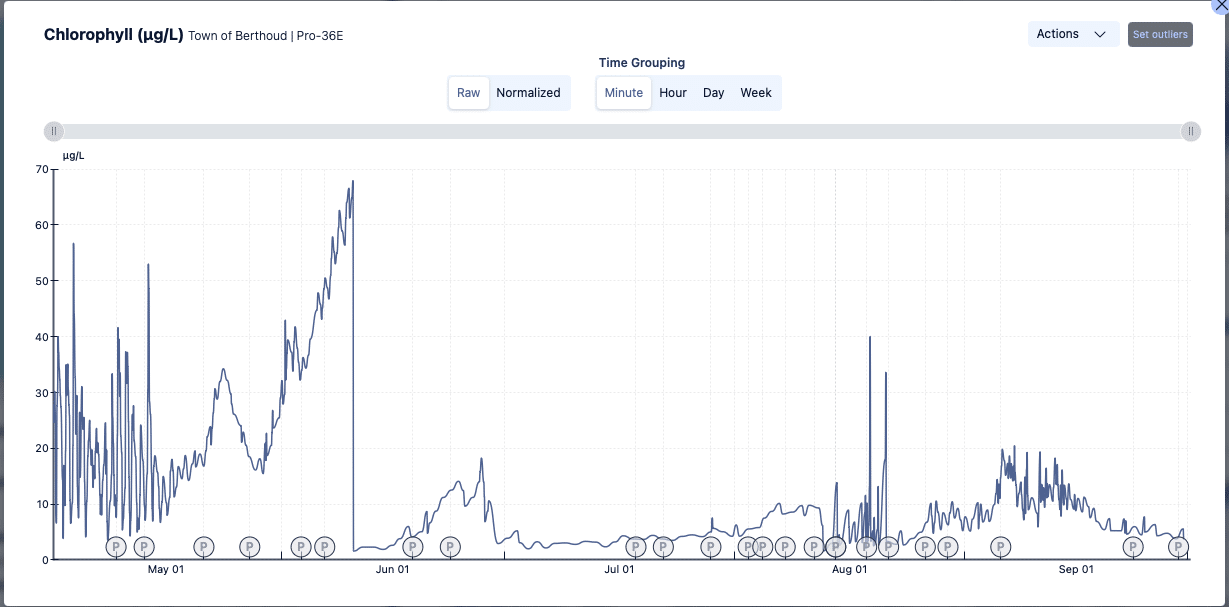
Chlorophyll-a levels showed a clear overall reduction from May through October 2025. After higher and more variable concentrations in late spring, values declined and remained largely lower and more stable through early summer. While occasional short-lived peaks were observed later in the season, overall chlorophyll-a concentrations trended downward toward autumn, indicating reduced algal biomass and improved source water conditions over time.
- During Summer 2025 (July through early September), taste and odor events were fewer and less intense compared to the previous year.
- When the MPC-Buoy system is operational, clear visual differences are observed between the East and West Cells, with significantly less floating algae present in the East Cell
- The East Cell showed noticeably reduced surface algae during peak summer months.
- PAC continues to be used seasonally, but dosing follows more predictable patterns based on geosmin and MIB levels, particularly during summer compared to fall, winter, and early spring.
- The greatest benefits were observed during periods of high water demand, high flow from the East Cell, and during prime turnover months.
Observations on operation and water quality
Area of Evaluation | Observations After MPC-Buoy Installation |
Taste & Odor Events | Fewer and less intense taste and odor issues observed during Summer 2025 (July–early September) compared to the previous year. |
Floating Algae | Noticeably less surface algae observed in the East Cell when the LG Sonic system is operational. |
Reservoir Cell Comparison | The West Cell typically shows more floating algae during summer, while the East Cell shows reduced algae when treated. |
Seasonal Impact | Most noticeable benefits occurred during summer months and during prime turnover periods. |
Raw Water Conditions | Reduced algae and organic matter entering the treatment plant from the East Cell. |
Plant staff and operators shared the following observations on the system’s performance:
“The LG Sonic device has effectively reduced the amount of algae and organic matter entering the Berthoud water treatment plant. The device requires little maintenance, is easy to use, and allows for remote data collection. Overall, I believe the LG Sonic is an excellent tool that simplifies the water treatment process during the warmer months.“
Discussion
The 2025 season highlighted the strongest operational benefits of the MPC-Buoy system, particularly during periods of high production demand and seasonal turnover. By reducing algae growth in the East Cell before water reached the treatment process, Berthoud improved raw water conditions and simplified treatment adjustments during the most challenging months of the year.
Operators also noted clear visual confirmation of the system’s impact, observing reduced surface algae in the East Cell compared to the West Cell when the system was active.
Conclusion
Berthoud’s experience demonstrates how proactive, source-level algae control combined with real-time monitoring can reduce the intensity of taste and odor challenges and support more stable treatment operations.
By deploying LG Sonic technology in the reservoir, the Town of Berthoud improved raw water quality during peak summer conditions, gained better insight into reservoir dynamics, and supported a more predictable and efficient treatment process.
When asked to describe LG Sonic technology, Berthoud summarized it as:
“Effective and reliable technology provides a proactive solution for monitoring and controlling algae, and the overall health of the reservoir.”