
Chemical-Free Algae Control Cuts Treatment Plant Costs at a California Drinking Water Reservoir
Project summary
The Donner Summit Public Utility District (DSPUD) supplies drinking water from Lake Angela, an 18-acre reservoir in California’s Sierra Nevada. For years, recurring blooms meant algae clogging water treatment filters every summer. As a result, chemical dosing climbed, and filter cleaning consumed millions of gallons of finished water. In 2025, a single MPC-Buoy changed that pattern. During its first season, plant-cleaning water use dropped 45%. Influent turbidity fell 67%. Moreover, the District saved roughly $86,000 on water alone. Consequently, the Board extended the program for two more years in November 2025.
The challenge: algae clogging filters, rising costs
Algal blooms are part of Lake Angela’s history. Significant events occurred in 2009, 2015, 2016, 2022, and 2024. Sampling showed green algae such as Chlorella sp. and Oocystis sp., together with the diatoms Navicula, Cocconeis, and Cyclotella. In other words, a mixed algal community — and one that strained the treatment plant downstream.
Each summer, rising cell counts moved through the plant in sequence. First, filters blinded faster. Next, clarifiers ran near their limits. Meanwhile, operators raised chemical dosing to break down the incoming algae. Killing the cells created a new burden, however. The residue built up in the process. Therefore, crews backwashed filters and flushed clarifiers far more often, and every cycle consumed finished water.
“When the algae in the lake got out of control, we had little choice but to add large amounts of chemicals to kill them. Unfortunately, the dead algae then clogged the system and forced us to flush everything out.”
— Steven Palmer, PE, CSDM, General Manager, DSPUD
Weighing the alternatives
Before choosing ultrasound, the District weighed its alternatives. Dosing the reservoir itself with algaecides came up first. However, the Board set that idea aside early — “we wanted to avoid that, just from an environmental point of view,” Palmer said. The team also evaluated a coagulation-based pre-treatment stage. That route required a pilot study first, which meant more budget and more waiting. Instead, DSPUD wanted proof within a single bloom season, at a defensible cost.
“The buoy just seemed like a simple, straightforward, elegant solution.”
— Cathy Preis, President, Board of Directors, DSPUD
Project Summary
45% less backwash & flush water
The plant used 8.0 million fewer gallons of finished water for backwashing and clarifier flushing than in 2024.
67% lower influent turbidity
Average turbidity entering the drinking water plant dropped from 2.8 NTU to 0.9 NTU across the bloom season.
~$86K first-year savings
DSPUD saved about $86,000 on water use alone in year one, before counting any chemical savings.


The solution
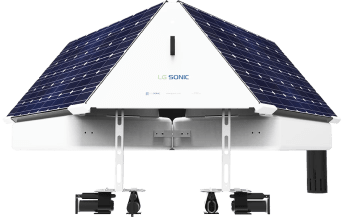
DSPUD’s Board of Directors approved a single MPC-Buoy in January 2025. The system went into the water in spring, ahead of the bloom window that usually runs into late October. Soon after, the District introduced the buoy to its community through a public notice on its website, describing the technology as “providing healthier water for your money.”
The MPC-Buoy sends low-power ultrasound into the upper water layer. The sound field disturbs the algae’s ability to hold their position near the surface. As a result, cells settle away from the sunlight they need to multiply. Power level matters here. Ultrasound strong enough to tear cells open can release stored toxins into the water. For that reason, the MPC-Buoy suppresses growth while leaving cells intact.
An algal community also shifts over the season, so treatment cannot stay static. The solar-powered buoy carries onboard sensors. These stream water-quality data to MPC-View, LG Sonic’s monitoring platform. Based on that data, LG Sonic’s specialists tune the ultrasonic program remotely. In this way, treatment keeps countering the minority of cells that could otherwise adapt to a single fixed frequency.
First-season results
algae clogging water treatment filters: 45% less backwash and flush water
July through October marks the peak of Lake Angela’s bloom season. Across those months, the plant used 9.8 million gallons of water for backwashing and clarifier flushing. In 2024, the same months required 17.8 million gallons. In other words, the District saved 8.0 million gallons of finished water — a 45% reduction. Furthermore, the gap widened as the season progressed. July closed 32% below the prior year. By October, historically the hardest month, the reduction reached 64%.
Month | 2024 volume (MG) | 2025 volume (MG) | Change (MG) | Reduction |
July | 4.43 | 2.99 | −1.44 | 32% |
August | 4.48 | 2.67 | −1.81 | 40% |
September | 4.31 | 2.49 | −1.81 | 42% |
October | 4.55 | 1.61 | −2.94 | 64% |
Total | 17.78 | 9.77 | −8.01 | 45% |
Table 1. Water used for filter backwash and clarifier flushing, July–October, 2024 vs. 2025. Monthly figures are rounded; totals reflect unrounded data.
Influent turbidity down 67%
Raw water quality told the same story. On average, influent turbidity at the drinking water plant fell from 2.8 NTU to 0.9 NTU — a 67% improvement. October’s reading dropped from 3.4 NTU to 0.6 NTU, an 82% decline. Even July, typically the mildest month, came in 72% lower.
Month | 2024 volume (MG) | 2025 volume (MG) | Change (NTU) | Reduction |
July | 1.8 | 0.5 | −1.3 | 72% |
August | 2.5 | 1.4 | −1.1 | 44% |
September | 3.4 | 1.1 | −2.3 | 68% |
October | 3.4 | 0.6 | −2.8 | 82% |
Total | 2.8 | 0.9 | −1.9 | 67% |
$86,000 saved in year one
The financial result landed close to the District’s own business case. In total, DSPUD saved approximately $86,000 in its first year, from reduced water consumption alone.
“It was pretty close to what we had estimated before we made the purchase. That’s not really including chemical costs — it’s too early to quantify those.”
— Steven Palmer, PE, CSDM, General Manager, DSPUD
Chemical savings should add to that figure. However, DSPUD prefers to quantify them after a full season-over-season comparison.
What’s next
The Board reviewed the first season’s data in November 2025. On that basis, it approved two further years of treatment. Beyond continued algae control, DSPUD plans to use MPC-View’s reporting tools more actively. The goal: share clear results with the Board and elected officials, and put a firm number on the chemical savings. For a plant that once fought algae clogging water treatment filters every summer, the operating picture now looks very different.
“We definitely noticed very large improvements in the treatment process. We’re backwashing a lot less and using fewer chemicals. It’s a fascinating technology.”
— Steven Palmer, PE, CSDM, General Manager, DSPUD
As featured on Water Online
Water Online published this project as a case study in August 2026. Read the article here:
How Donner Summit PUD Cut Backwash Water Use By 45% With Ultrasonic Algae Control.
MPC-Buoy
All-in-one solution for controlling algae in large water reservoirs.