

FAQs
Find answers to common questions about algal blooms, LG Sonic ultrasonic algae control technology, applications, and implementation.
Algal Blooms
What causes algal blooms?
Algal blooms are primarily caused by excess nutrients, particularly phosphorus and nitrogen, entering a water body through agricultural runoff, wastewater discharge, or urban stormwater. Warm temperatures and calm, stratified water conditions accelerate growth.
Are all algae harmful?
No. Most algae are a natural and beneficial part of aquatic ecosystems. Problems arise when certain species, especially cyanobacteria, grow in excessive quantities, producing toxins and depleting oxygen levels.
How long does an algal bloom last?
The duration varies depending on nutrient availability, water temperature, and weather conditions. Blooms can persist for days, weeks, or in some cases months if conditions remain favourable and no intervention is applied.
What is the most effective way to control algal blooms?
Sustainable bloom control combines nutrient reduction at source, continuous water quality monitoring, and targeted treatment. Ultrasonic technology such as LG Sonic’s MPC-Buoy, disrupts algae growth without chemicals or harm to other aquatic life.
Technology & How It Works
How does ultrasonic algae control work?
LG Sonic uses targeted ultrasound frequencies between 20-500 kHz to disrupt algae cell structures. The ultrasonic waves create microscopic pressure that specifically targets gas vesicles—the structures that allow algae to float and photosynthesize. When these gas vesicles are disrupted, algae sink below the photic zone where they cannot access sufficient light for photosynthesis, causing them to die naturally. The system automatically adjusts frequencies based on the dominant algae species present, using real-time water quality monitoring to optimize treatment.
Learn more:
Is ultrasound safe for fish, plants, and wildlife?
Yes. Ultrasonic algae control is completely safe for fish, aquatic plants, zooplankton, beneficial bacteria, and wildlife. The frequencies used (20-500 kHz) target only algae gas vesicles—fish do not have gas vesicles and are unaffected by these frequencies. The technology has been extensively tested and validated through independent studies by the University of Hull (UK), Delft University of Technology (Netherlands), and multiple environmental agencies. LG Sonic systems are approved for use in drinking water reservoirs, fish farms, and ecologically sensitive environments.
Learn more:
How long does it take to see results?
Results typically become visible within 2-4 weeks of installation, though timelines vary based on initial algae biomass, nutrient levels, water temperature, and water body size. The City of Archie (Missouri) observed clear water in just 3 weeks during peak summer bloom season. Chilmark Pond achieved results 3 times faster than expected. Heavy algae blooms may require 4-8 weeks for complete control. See more case studies for documented timelines.
What types of algae can the system control?
LG Sonic systems control all major categories of problematic algae. The system is most effective against cyanobacteria (blue-green algae), including Microcystis, Anabaena, Oscillatoria, Planktothrix, and Cylindrospermopsis. Green algae (Chlorella, Scenedesmus, Chlamydomonas) and diatoms (Cyclotella, Asterionella) can also be controlled. The MPC-Buoy system identifies specific algae species present and automatically adjusts ultrasonic frequencies to target the dominant species.
What is the minimum water depth required?
The MPC-Buoy requires a minimum depth of 1 meter (approximately 3 feet) to operate effectively. This ensures proper anchoring and allows the ultrasonic signal to propagate evenly across the water column. There is no maximum depth limitation; the system works effectively in both shallow and deep reservoirs. For smaller water surfaces, contact our team to know more about E-Line.
Does the system work in saltwater or brackish water?
Yes. LG Sonic technology operates effectively in freshwater, brackish water, and marine environments. The ultrasound program and materials are adapted to the conductivity and salinity levels of each site. Saltwater units use corrosion-resistant marine-grade stainless steel and titanium transducers. Learn more about various water applications.
Coverage & Technical Specifications
How much area does one buoy treat?
One MPC-Buoy treats up to 500 meters in diameter (approximately 800 feet radius), covering 20-120 acres. Actual coverage depends on local conditions including wind direction, fetch, turbidity levels, and basin shape. For larger water bodies, multiple buoys are strategically positioned to ensure complete coverage. See implementation examples from various project sizes.
What are the MPC-Buoy dimensions and weight?
The MPC-Buoy measures approximately 2.2 meters x 2.2 meters (triangle-based design) and weighs approximately 200 kilograms (450 pounds), excluding the anchoring system. The compact design allows for easy boat-based installation and requires no cranes or special equipment.
What power source does the system use?
MPC-Buoys are powered by three 215W solar panels with integrated lithium battery systems, providing autonomous operation with zero energy costs. Grid-powered units are also available and use less than 50W per device (approximately $50-150 / €46-€138 annually in energy costs). Learn more about the sustainable technology design.
How accurate are the water quality sensors?
LG Sonic monitoring systems provide laboratory-comparable accuracy for routine water quality parameters. pH sensor: ±0.1 pH resolution and accuracy. Temperature sensors: ±0.5°C accuracy with response times under 5 seconds. The systems take measurements every 15 minutes. Explore the phosphate monitoring capability for nutrient tracking.
Installation & Operations
How difficult is installation?
Installation is straightforward, though timing varies based on site-specific factors including distance from the water body to land, number of buoys, team size, weather conditions, and site accessibility. Experienced teams have successfully installed up to 6 buoys within 1-2 days under favorable conditions. The system requires no infrastructure modifications—floating buoys only need anchoring with no electrical work, piping, or construction required. Contact us for installation support and training.
Can the system operate year-round in cold climates?
Yes, but removal during extended freezing periods is recommended. In regions with 4-6 months of ice, most operators remove the electronic components to prevent damage. The removal process takes approximately 30 minutes with basic hand tools. See City of Minneapolis and Town of Superior for cold-climate implementations.
How does the system handle storms and heavy rainfall?
The MPC-Buoy continues operating during and after storms, with sensors tracking changes in real time. The buoy is anchored and designed to withstand waves, wind, and currents. Real-time monitoring through MPC-View allows operators to track storm impacts.
Can the system work with existing aeration systems?
Yes. Ultrasound can complement aeration when installations are properly engineered. Deep reservoirs often benefit from combining aeration (for oxygen/mixing) with ultrasonic treatment (for algae control). Contact our team for site-specific recommendations.
Can the system integrate with SCADA or PLC systems?
Yes. LG Sonic provides RESTful API access for pulling real-time and historical data into SCADA, LIMS, or custom dashboards. The Digital Twin platform offers comprehensive data integration capabilities.
Maintenance & Reliability
How often is maintenance required?
During high algae season (spring/summer), monthly inspections are recommended, taking 45-60 minutes per unit. During low season, quarterly inspections are sufficient. Annual comprehensive servicing typically requires 1-2 hours per unit. The Aquawiper™ automatic cleaning system reduces fouling and maintenance requirements significantly.
Learn more:
How often do sensors require calibration?
LG Sonic uses a sensor replacement approach rather than field calibration to ensure optimal accuracy. Sensors are replaced based on performance data and monitoring requirements. Many sensors feature automatic calibration and anti-fouling systems to minimize maintenance. The Vertical Profiler system’s modular design makes sensor replacement quick and straightforward.
What is the expected lifespan of the equipment?
The MPC-Buoy is covered by a 2-year warranty (sensors: 1-year warranty). The system is designed for long-term operation, with a modular design that allows component replacement to extend operational life. See long-term case studies demonstrating durability. See long-term case studies demonstrating durability.
Are spare parts readily available?
Yes. Spare parts and replacement components are available from LG Sonic’s manufacturing facility in the Netherlands. The modular design allows for straightforward component replacement. Delivery timing depends on your location and the specific part needed. Contact support for parts availability, shipping timelines, and to discuss maintaining backup components on-site for critical applications. Contact support for parts availability and service.
Monitoring & Data Management
What water quality parameters can be monitored?
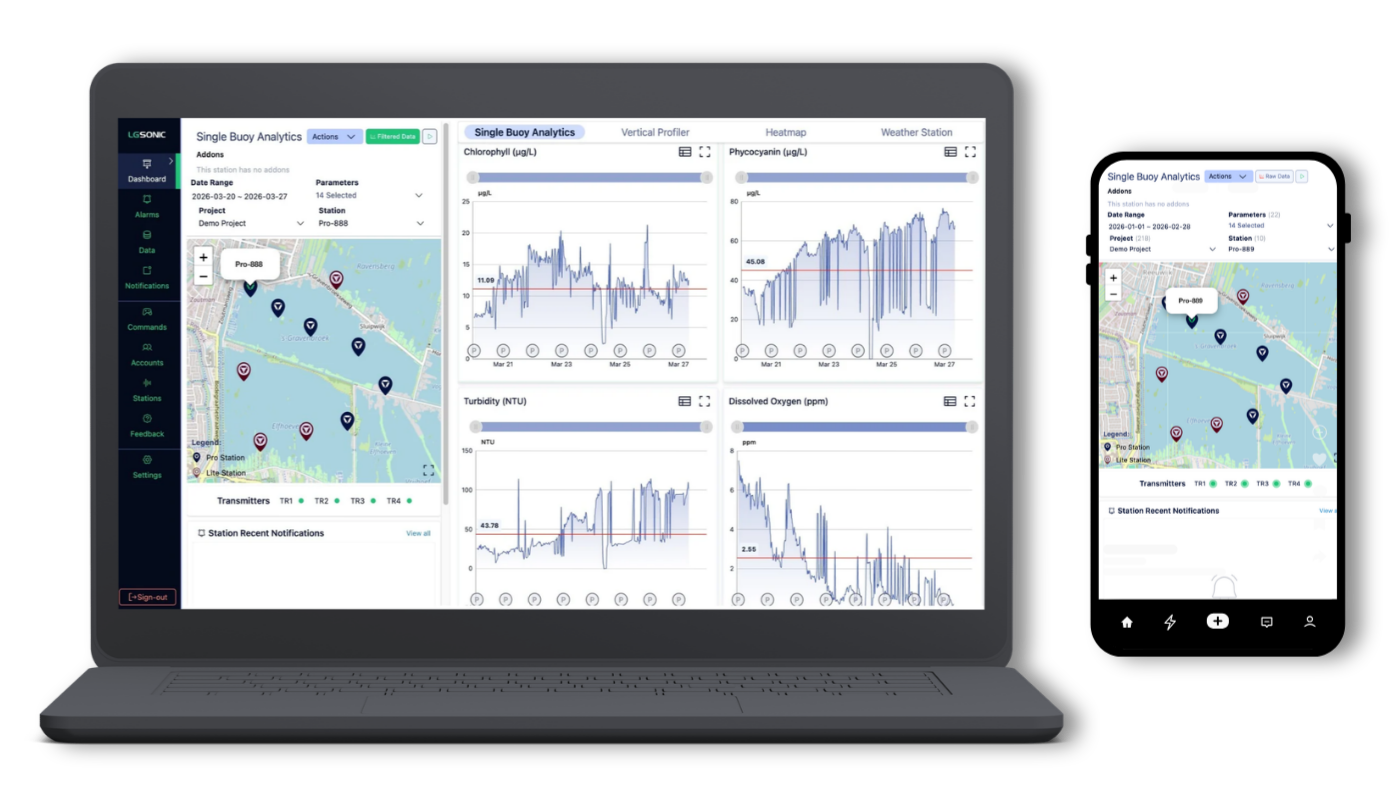
LG Sonic monitoring systems measure: chlorophyll a, phycocyanin, dissolved oxygen, pH, turbidity, temperature, conductivity, and optional nutrient levels. The MPC-Buoy takes measurements every 15 minutes, providing 96 data points per day per parameter.
What is MPC-View?
MPC-View is LG Sonic’s cloud-based platform for water quality data management. The platform provides real-time dashboards, automated alerts, predictive analytics, historical trend graphs, and downloadable compliance reports.
How does AI improve algae control?
LG Sonic’s Interactive Algae Control integrates AI-based algorithms with real-time monitoring. The AI learns site-specific patterns and automatically adjusts the ultrasonic program to prevent algal growth proactively, with remote expert supervision. This approach is demonstrated in the CEDAE Brazil and American Water New Jersey implementations.
Who owns the monitoring data?
Customers own their data and receive secure access to dashboards, reports, and historical archives through MPC-View. Access is controlled through individual or shared login accounts with flexible user permissions.
Costs & Return on Investment
What does an LG Sonic system cost?
Pricing depends on water body size, buoy requirements, monitoring needs, and complexity. One MPC-Buoy typically covers 20-120 acres. Contact us with your site details for a customized proposal and ROI analysis.
What is the typical return on investment?
Most organizations achieve ROI within 1-3 years. A 50-hectare reservoir spending $80,000 (€73,600) annually on chemicals typically achieves ROI within 2 years. Savings include a 60-100% reduction in chemical costs, labor reduction, and infrastructure protection. See the City of Archie case study, Chesterfield County, and American Water New Jersey for documented ROI results.
What are the operating costs compared to chemical treatment?
Organizations consistently report a 60-100% reduction in chemical treatment costs after implementing LG Sonic systems. The Vallecitos Water District eliminated $25,000-$35,000 in annual chemical expenses. Other utilities have achieved savings exceeding $87,000 annually. Solar-powered systems have zero energy costs, and maintenance requirements are minimal compared to continuous chemical dosing. See case studies for documented savings. Multiple case studies document these savings across different water body types.
Does the system require ongoing chemical purchases?
No. LG Sonic systems typically eliminate the need for chemical algaecides. Organizations report 60-100% reductions in chemical usage. See American Water New Jersey case study and CEDAE Brazil for documented chemical elimination.
Safety & Environmental Impact
Is the system safe for swimmers and recreational users?
Yes. The ultrasound frequencies operate outside human hearing range and cause no health effects. The technology improves swimmer safety by controlling toxic cyanobacteria, eliminating the need for beach closures. See Lake Tanglewood case study and other recreational lake applications for water quality results.
Does ultrasound affect beneficial bacteria?
No. Beneficial bacteria for bioremediation and wastewater treatment are not negatively affected. By controlling excessive algae, the system helps maintain balanced conditions for natural decomposition. Learn more about lake ecosystem health.
What happens to algae after ultrasonic treatment?
Controlled algae naturally decompose through aerobic bacterial activity. When algae are disrupted early in their growth cycle, there is much less biomass settling compared to natural die-off or chemical treatment. This is explained in detail in The Science Behind Interactive Algae Control.
What environmental certifications does the technology have?
LG Sonic holds NSF/ANSI 61 certification for drinking water (US/Canada), CE marking with EU Drinking Water Directive compliance, and FCC/IC electronic certifications. Independent studies by the University of Hull and Delft University confirm no harm to aquatic life. Learn more about safety testing.
Does ultrasonic treatment help meet regulatory requirements for algal toxins?
Yes. Ultrasonic treatment proactively prevents toxic blooms, helping facilities stay below US EPA guidelines (1.6 µg/L recreational, 0.3 µg/L drinking water) and WHO standards. MPC-Buoy data provides auditable compliance records for regulatory reporting.
Applications & Performance
What types of water bodies can benefit from ultrasonic algae control?
LG Sonic technology is effective across diverse water environments: drinking water reservoirs, irrigation ponds, industrial cooling towers (5-15% efficiency improvement), recreational lakes, golf course ponds, fish farms, wastewater lagoons, and power generation facilities. Explore all applications.
How effective is the system in aquaculture applications?
The MPC-Buoy is highly suitable for aquaculture. By controlling algae, pH remains more neutral, ammonia is less toxic, and dissolved oxygen saturation improves. This causes fewer stresses to fish, resulting in superior product quality. See aquaculture implementations in our case studies.
Can the system work in very large reservoirs or lakes?
Yes. LG Sonic has deployed systems in reservoirs exceeding 1,000 hectares using multi-device arrays, hydrodynamic modeling, phased deployment, and networked monitoring. Per-hectare costs decrease significantly as project size increases. See CEDAE Brazil for large-scale implementation examples. Contact us for scalability analysis.
Does the system work on filamentous algae?
Ultrasound is effective on filamentous algae during its unicellular growth phase. Once mature and attached, physical cleaning is recommended. The most effective approach combines ultrasonic prevention with periodic mechanical removal.
Can ultrasonic treatment work in flowing rivers or streams?
Ultrasonic treatment is most effective in static or slow-moving water. Slow-flow canals under 0.3 m/s work with standard deployment. For rivers, focus on treating upstream source ponds or intake basins where water is detained. Contact our technical team for site-specific assessment.
Comparison & Decision Factors
How does ultrasonic treatment compare to chemical algaecides?
Ultrasonic treatment offers significant advantages: 100% safe with no residues vs toxic chemicals, continuous prevention vs temporary control, quarterly inspections vs weekly applications, $2,000-5,000 (€1,840-€4,600) annual costs vs $15,000-150,000+ (€13,800-€138,000+), and zero environmental footprint vs bioaccumulation concerns. See case studies comparing chemical-free results with previous chemical programs.
How does ultrasonic treatment compare to aeration systems?
Aeration improves dissolved oxygen and destratifies water but requires 1-5 kW continuous energy. Ultrasonic treatment directly disrupts algae with minimal energy (under 50W). Shallow ponds typically need ultrasonic treatment alone; deep reservoirs may benefit from combining both. Learn more about integrated water treatment solutions.
Solving Common Water Quality Problems
How can I solve taste and odor problems in drinking water?
Taste and odor problems are primarily caused by cyanobacteria producing geosmin and MIB. LG Sonic’s ultrasonic technology prevents cyanobacterial blooms before they produce these compounds. This proactive prevention is more effective and cost-efficient than reactive treatments like activated carbon filtration. See the CEDAE Brazil case study for documented Geosmin reduction results in a major drinking water system.
Learn more:
How can I improve lake water quality and ecosystem health?
Improving lake quality requires controlling excessive algae while supporting natural ecosystem balance. LG Sonic maintains algae at sustainable levels rather than complete elimination, supporting the aquatic food web. Improved water clarity allows sunlight penetration for beneficial plants, increased dissolved oxygen supports fish, and reduced cyanotoxins create safer habitats. See the Lake Tanglewood case study and other recreational lake applications for ecosystem restoration results.
Learn more:
Is ultrasound effective for harmful algal blooms? Can algae adapt to ultrasound?
Yes, ultrasound is highly effective for HABs. The concern about adaptation is addressed through Interactive Algae Control—continuously varying ultrasonic frequencies rather than using fixed frequencies. LG Sonic’s AI-based system constantly adjusts based on real-time monitoring and species composition. Field installations operating for 5+ years continue to show consistent effectiveness with no evidence of adaptation. See long-term results in case studies across multiple years of operation.
Learn more:
Cannot find the answer you were looking for?
Feel free to reach out via our contact form. For press questions, please email [email protected].