

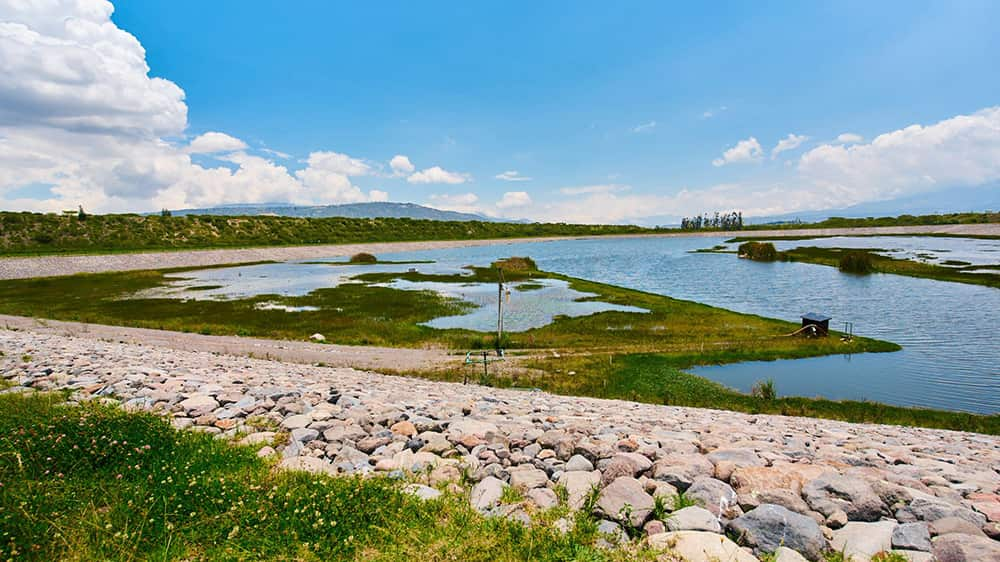
How Quito Airport Eliminated Algae Blooms, Without Chemicals
Mariscal Sucre International Airport in Quito, Ecuador, manages a 17-hectare rainwater reservoir on site. For years, that reservoir was a recurring operational headache: aggressive algal blooms were pushing water pH to 9–10, generating foul odours, threatening aquatic health, and triggering costly interventions involving heavy machinery and chemical treatments.
In 2017, Quiport, the company responsible for operating and maintaining the airport, turned to LG Sonic for water surface management. Seven years later, they’re still running our equipment and have upgraded to the latest hardware.
We sat down with their Environmental Health and Safety Manager, Gabriela Landazuri, to understand what changed.
The Problem: Algae Was Costing More Than Expected
On the surface, algal blooms in a rainwater reservoir appear to be a water quality issue. In practice, they’re an operational and financial one.
For Quiport, the compounding costs were high:
- Chemical treatments required repeated purchasing, specialist application, and disposal
- Heavy machinery mobilisation added labour and equipment hire costs
- pH levels at 9–10 made the water corrosive, damaging infrastructure and creating compliance risks
- The ongoing effort diverted environmental management staff from higher-value work
The airport needed a solution that would remove the blooms reliably, reduce operational overhead, and eliminate the environmental and reputational risks of chemical use in a public infrastructure setting.
The Solution: MPC-Buoy Deployment at the Reservoir
LG Sonic installed an MPC-Buoy in the reservoir, a solar-powered device that uses targeted ultrasonic frequencies to inhibit algae growth and prevent bloom formation.
The technology works by disrupting the buoyancy control of cyanobacteria, forcing them below the photic zone where they cannot photosynthesize. There are no chemicals involved. No mechanical extraction. No residual impact on aquatic ecosystems.
The MPC-Buoy also provides real-time, remote water quality monitoring, giving Quiport’s environmental team continuous visibility of pH, temperature, and algae indicators without on-site manual sampling.
The Results
|
pH 9–10 → normal |
Water pH returned to safe levels after MPC-Buoy deployment |
|
100% chemical-free |
All algaecide and chemical treatment eliminated |
|
↓ Operational costs |
Reduced manpower and equipment hire requirements |
|
Solar-powered |
Zero grid energy draw — MPC-Buoy runs on renewable power |
|
Since 2017 |
Ongoing partnership; Quiport has upgraded to the latest hardware |
“Since installing LG Sonic’s equipment, we have seen a complete transformation in our reservoir,” said Gabriela Landazuri, Environmental Health and Safety Manager at Quiport. “The technology is reliable, the monitoring is excellent, and it has allowed us to meet our sustainability commitments without compromising on performance.”
Why Airport Operators Choose LG Sonic
Airport reservoirs present specific challenges: they tend to be large, they’re subject to intensive nutrient runoff from surrounding land use, and chemical treatment carries regulatory and reputational risk in public infrastructure contexts.
LG Sonic’s MPC-Buoy is designed for exactly these conditions:
- Scalable to reservoirs from 1 to 100+ hectares
- Solar-powered — no grid infrastructure required
- Remote monitoring integrates with existing environmental management dashboards
- Approved for use in drinking water reservoirs, recreational lakes, and industrial water bodies
- No chemical permits required
Quiport has been a customer since 2017. That kind of retention is the result of a technology that delivers — not once, but consistently, across every seasonal cycle.
Full Case Study
Hear directly from Gabriela Landazuri about Quiport’s experience implementing LG Sonic technology at Mariscal Sucre International Airport.
Read the full case study: https://www.lgsonic.com/cases/quiport/