

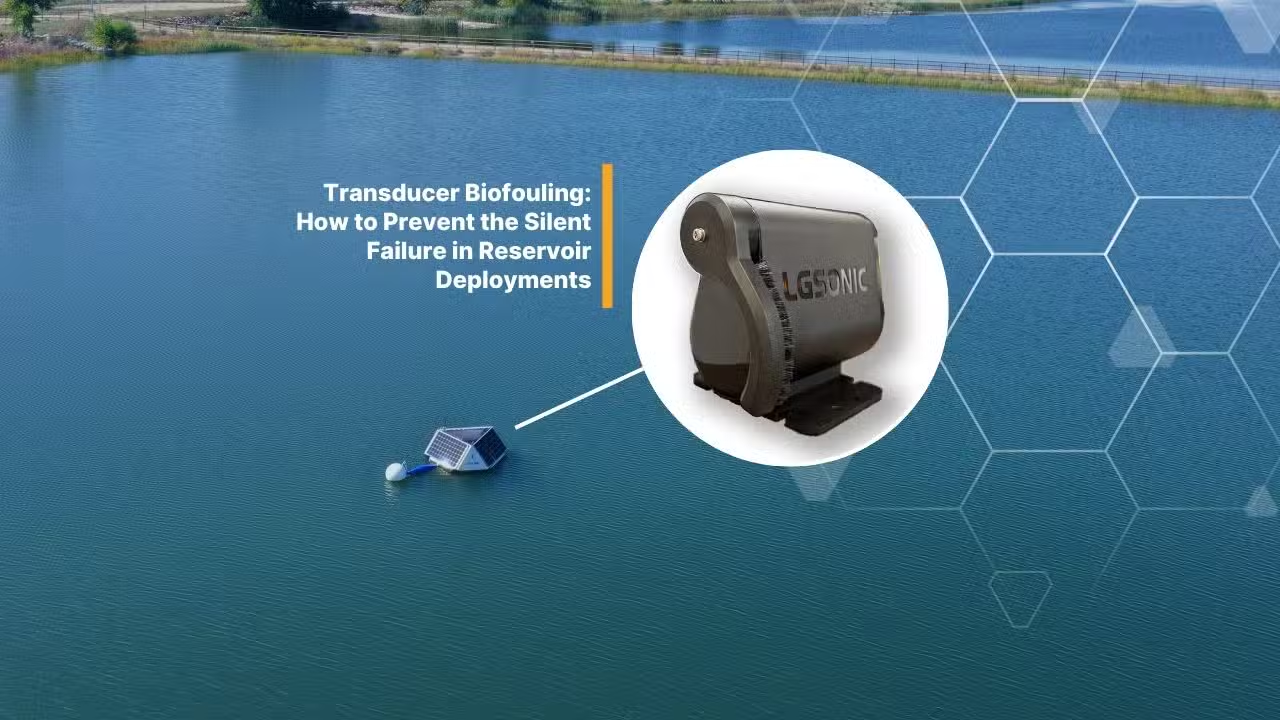
The system is still running. The solar panel is charging. The status light is green.
But algae are back in the reservoir. Carbon doses at the plant are climbing. Operational costs are rising. Consumer complaints are landing on the desk.
Most operators only discover why weeks later: transducer biofouling has silently disabled the treatment, the output never leaves the housing, and every week of delay compounds the treatment spend.
If you see any of these, your system is likely already fouled:
- Algae blooms are returning in the reservoir despite the system reporting “operational”
- Water looks clear near the buoy, but blooms persist elsewhere in the water body
- Taste and odor complaints are rising during warm months
- Activated carbon consumption and treatment spend are climbing year over year
- No performance data beyond on/off status; last transducer inspection was months ago or never
Three factors that determine algae treatment performance in reservoirs
In reservoir deployments, algae treatment performance depends on three factors:
- System design and coverage: Is the treatment sized and positioned correctly for the water body?
- Calibration and operating conditions: Is the system tuned to the target algae species and the site’s biology?
- Transducer condition over time: Is the acoustic emission surface staying clean through the deployment?
The first two factors are usually verified at installation and re-checked during service visits. The third is the one most often overlooked, and it’s the factor that decides whether a correctly-designed, correctly-calibrated system continues to perform through the bloom season or quietly stops delivering treatment.
The transducer condition over time is controlled by one variable: biofouling.
Why algae treatment performance declines in reservoirs
Reservoir algae treatment systems rarely fail because of electronics. Performance decline almost always comes from biology, specifically what grows on the transducer face after deployment.
Once a transducer enters a reservoir, the water starts coating it. Proteins stick first. Then bacteria. Then, a slimy biofilm, and afterwards, in hard-water reservoirs, calcium carbonate on top of that.
The electronics keep running the whole time. The solar panel keeps charging. The system reports green. But the acoustic energy that is used to disrupt cyanobacteria never actually leaves the housing anymore.
The result: the treatment signal dies at the surface. This is a silent failure, and it is the defining problem of unattended reservoir deployment.
“Biofouling doesn’t reduce performance. It disables it.”
Transducer biofouling is the most common and most underdiagnosed reason algae treatment performance declines after deployment. The system didn’t break. It was silently shut down, one day at a time, by the same organisms it was installed to control.
What transducer biofouling actually is
Transducer biofouling is the buildup of biofilm and mineral scale on the face of an ultrasonic transducer. It blocks, reflects, or absorbs the sound energy that should enter the water and disrupt algae.
The MPC-Buoy controls algae by emitting calibrated ultrasonic waves through submerged transducers. The waves target gas vesicles inside cyanobacteria. They disrupt the buoyancy that keeps harmful algae near the surface. They also interfere with photosynthesis.
This only works when the full acoustic output reaches the water. A coated transducer cannot deliver it.
The invisible failure mode
A fouled transducer still draws power. It still reports status. But the acoustic energy reaching the algae can drop by half within the first days of biofilm formation. No operator sees this from the surface.
How fast biofouling forms: The deployment timeline
A freshwater reservoir coats every submerged surface fast. The transducer face is warm, smooth, and sits in nutrient-rich water. Biofouling organisms find it ideal.
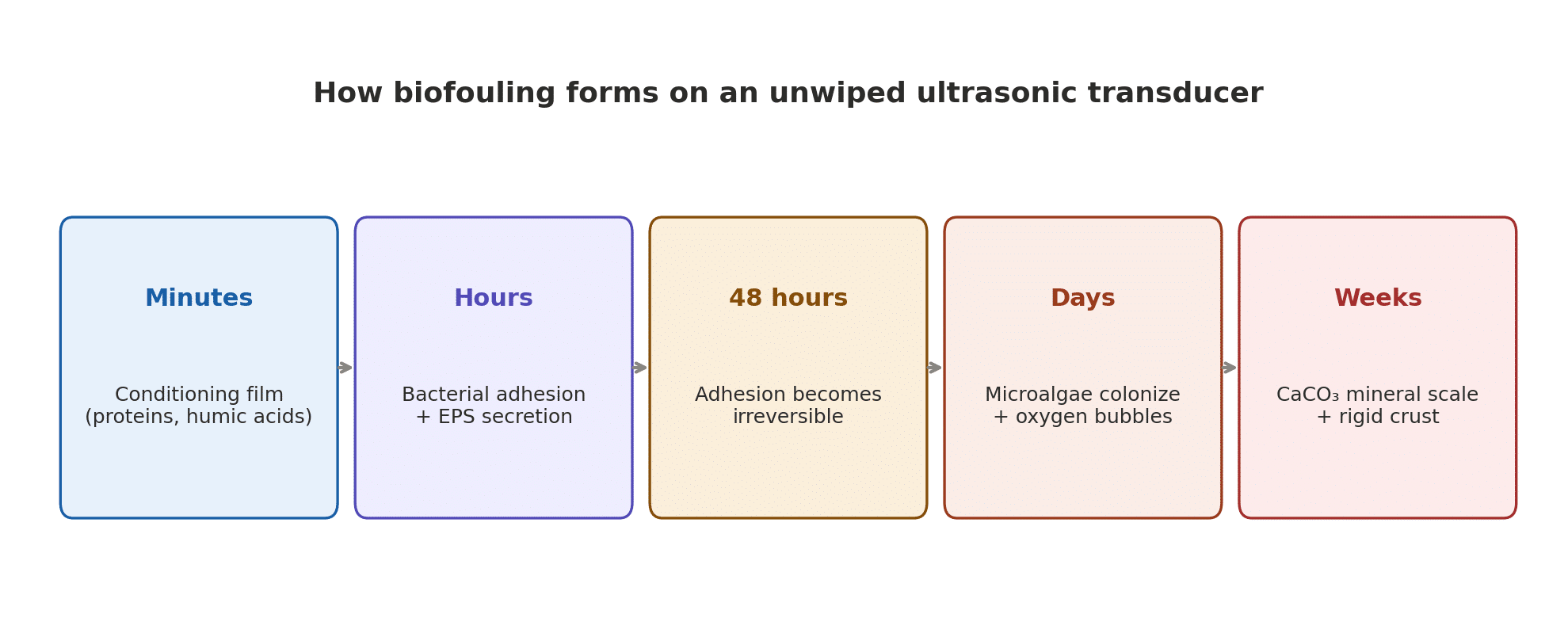
Within minutes, dissolved proteins form a conditioning film. This primes the surface for microbial attachment.
Within hours, bacteria adhere and secrete a sticky gel (Extracellular Polymeric Substances, or EPS). This gel cements them in place.
Within two days, the adhesion becomes irreversible. Passive cleaning no longer removes it.
Within days, microalgae colonize the biofilm and photosynthesize on the transducer face, producing oxygen bubbles that reflect acoustic energy back into the housing.
Within weeks, calcium carbonate precipitates on top of the biofilm in hard-water reservoirs, forming a rigid crust that no passive coating can remove.
The reality: deployment day is the only day the transducer is clean unless something actively keeps it that way.
TIME TO FAILURE | Without mechanical cleaning |
Day 0 | Clean transducer, full treatment power |
48 hours | Biofilm adhesion becomes irreversible |
Week 1 | Treatment effectiveness collapsing |
Week 3+ | System effectively inactive |
If your reservoir shows these signs, your system may already be underperforming. A performance assessment can confirm this early — request one here.
“The algae you deployed the system to control are the same organisms disabling it.”
Your system is reporting green. Is it still treating?
After week three without mechanical cleaning, most transducers are effectively inactive — electronics operational, treatment output gone. If algae are returning in your reservoir and treatment spend is climbing, a performance assessment can confirm whether biofouling is the cause before another bloom season is lost.
Why does algae treatment fail when the transducer is fouled
The transducer is a precision instrument. It is designed to convert electrical energy into acoustic energy at exactly the right frequency and power. Biofouling breaks this in four ways — all of them happening at once.
1. The signal bounces back instead of going out
A biofilm layer changes the acoustic properties of the transducer face. Energy that should enter the water reflects back into the housing. The treatment signal never reaches the algae.
Operational result: the system draws full power and delivers no treatment. Treatment spend continues; treatment outcome does not.
2. The transducer drifts off its design frequency
Biofilm and scale add mass to the transducer face. Added mass shifts the resonant frequency downward. The transducer starts operating off-frequency. It consumes more power and delivers less treatment.
Operational result: higher energy draw, weaker algae control — the worst possible cost-to-outcome ratio.
3. The treatment beam scatters
Fouling does not grow evenly. Patchy biofilm breaks the focused acoustic beam into scattered noise. Instead of targeting algae at depth, the transducer broadcasts weak noise in every direction.
Operational result: energy never reaches the water column at depth. Deep-water cyanobacteria proliferate untouched.
4. The biofilm absorbs the energy as heat
The biofilm gel absorbs mechanical energy through internal friction. That energy becomes microscopic heat inside the fouling layer. It never reaches the water.
Operational result: the transducer heats itself instead of treating the reservoir, and the algae population keeps growing.
If algae are returning despite an operational system, the transducer condition is the first factor to verify — schedule a performance assessment.

Why anti-fouling paint is not the answer
The obvious fix seems to be coating the transducer with an anti-fouling paint. It doesn’t work. Here is why.
The coatings contradict the mission. Biocidal paints leach toxic metals into the water. That defeats the purpose of a system deployed to protect water quality. It also violates the EU Biocidal Products Regulation.
They fail unpredictably. Coatings offer a limited protection window. Once they degrade, fouling resumes at full speed. Operators only find out when blooms return by which point weeks of treatment are already lost.
They don’t stop mineral scale. Calcium carbonate precipitation is a chemical process, not a biological one. No coating affects it. In hard-water reservoirs, scaling fouls the transducer regardless of paint.
You cannot solve a mechanical problem with a chemical one.
How to check if your transducer is fouled (without diving)
Direct inspection of a submerged transducer requires a dive team. In most reservoirs, that is not operationally realistic. But you don’t need to dive to know whether biofouling has taken hold. The evidence shows up in the reservoir, at the plant, and in your operational costs.
Signs in the reservoir
- Algae blooms are returning despite the ultrasonic system reporting operational status
- Water is visibly clearer directly around the buoy, but blooms persist further out
- Cyanobacterial biomass rises through the bloom season rather than holding steady
- Recurring blooms in the same area each year, even after the system was installed
Indicators at the treatment plant
- Activated carbon dosing increases season over season
- Taste and odor complaints — geosmin or MIB — returning in warm months
- Finished-water quality requiring more intervention than the first year after the buoy was deployed
- Rising operational cost for a reservoir that should be declining in treatment burden
Signs in the operations record
- No measurable performance data from the buoy beyond on/off status
- The transducer face has not been inspected or cleaned in the last season
- Seasonal decline in treatment effectiveness year after year
- Increasing chemical dosing to compensate for weaker source-water control
The conservative assumption: if any of these signals are present and the system has no automatic transducer cleaning, biofouling is the probable cause. The only way to rule it out is to pull the unit or to deploy a system with integrated mechanical wiping from the start.
“Without cleaning, the treatment signal dies at the surface, months before anyone notices.”
Recognise any of those signs? Here’s what happens next.
Our engineers review your deployment data, reservoir conditions, and operational history to confirm whether biofouling is the cause of performance decline — and whether your system is a candidate for the Aqua Wiper™ retrofit or a new MPC-Buoy deployment with integrated mechanical cleaning from day one.
How LG Sonic’s Aqua wiper™ prevents transducer biofouling
The Aqua wiper™ is LG Sonic’s answer: the first and only automatic ultrasonic transmitter cleanser, integrated into every MPC-Buoy. It solves biofouling mechanically, no chemicals, no divers, no schedules, and it holds treatment performance where it matters: across the full bloom season, without operator intervention.
01 — Sweeps before adhesion locks in
Operator outcome: algae control effectiveness holds from deployment day through the end of the season, not just the first week.
A motorized armature with non-abrasive silicone bristles sweeps the full transducer face every 60 minutes. At this interval, bacterial attachment is still weak, and EPS accumulation is minimal. As a result, the wipe resets the surface to near-pristine acoustic condition every hour, around the clock.
02 — Prevents mineral scale nucleation
Operator outcome: no transducer retrieval, no descaling, no scheduled dive team. The system runs in reservoirs where nothing else does.
Calcium carbonate crystals require biological scaffolding to nucleate. By removing the biofilm layer every hour, the wiper eliminates the micro-topological sites where CaCO₃ crystallization begins. Consequently, no scaffold means no scale, even in high-alkalinity reservoirs where scaling is normally aggressive.
03 — Maintains factory calibration continuously
Operator outcome: treatment effectiveness is stable and predictable. The system performs in month six the way it performed on day one.
With the transducer face kept clean, the impedance gradient, resonant frequency, beam directivity, and mechanical Q-factor all operate exactly as designed. Therefore, every watt of power drawn from the solar-charged battery converts into directed ultrasonic treatment energy reaching the algae.
The Aqua wiper™ is the only solution that addresses biofilm and mineral scale at the same time — without adding chemicals to the water the system is designed to protect. The result: continuous algae control across the full bloom season, with zero on-site intervention.
A clean transducer is the difference between algae control and the algae control process.
With vs without mechanical cleaning: what changes for the operator
The difference between a deployed ultrasonic system with integrated wiping and one without it is not subtle. It shapes every downstream cost, risk, and outcome through the treatment season.
Without mechanical cleaning | With integrated Aqua wiper™ |
Treatment declines within days | Treatment remains stable across the season |
Algae return; costs climb at the plant | Algae control holds; treatment spend drops |
Problem invisible until blooms reappear | Performance known continuously, not rediscovered |
Dive teams or system retrieval required | Zero on-site intervention across deployment |
Season ends reactive | Season ends predictable |
The decision anchor: integrated mechanical wiping is not an accessory. It is what separates ultrasonic algae control that works from ultrasonic algae control that reports.
When does transducer biofouling happen most aggressively
Four reservoir conditions drive biofouling speed:
- Water temperature: Warm water accelerates microbial growth.
- Nutrient loading: High phosphorus and nitrogen fuel both target algae and biofilm organisms.
- Water hardness: Harder water adds aggressive calcium carbonate scaling on top of the biofilm.
- Sunlight and depth: Transducers in the photic zone get colonized faster.
Most managed freshwater reservoirs for drinking water, irrigation, or cooling have all four conditions in warm months. That is why continuous hourly wiping is not overkill. It matches the actual rate of biofilm attachment in real deployment conditions.
The operational reality: Why unattended deployment demands it
Most reservoirs where the MPC-Buoy is deployed cannot be manually cleaned. Large reservoirs need dive teams. Remote sites require expensive visits. Drinking water reservoirs restrict access.
In these conditions, the difference between a wiped transducer and an unwiped one is the difference between continuous algae control across a full bloom season and a system that silently went offline in week one.
Utilities in Gainesville, Georgia, Johnstown, and Berthoud, Colorado, all share the same operational requirement: treatment must hold across the full season, without on-site intervention. That is only possible when transducer biofouling is prevented, not managed after the bloom returns.
Frequently Asked Questions about transducer biofouling
What is transducer biofouling?
Transducer biofouling is the buildup of biofilm, microalgae, and mineral scale on the face of a submerged ultrasonic transducer. As a result, it blocks and absorbs the acoustic energy the device is designed to transmit. Furthermore, without mechanical cleaning, biofouling disables treatment within days of deployment, even though the system continues to report operational.
Why did my ultrasonic algae control system stop working?
In most cases, the reason is transducer biofouling. Although the system’s electronics remain functional, a biofilm coating on the transducer face prevents acoustic energy from reaching the water. Consequently, from the surface, nothing looks wrong, which is why the problem is often diagnosed only when algae return to the reservoir.
How fast does biofouling form on an ultrasonic transducer?
Biofouling begins within minutes of deployment. First, bacteria attach within hours, and adhesion becomes irreversible within about 48 hours. Next, microalgae colonize the biofilm within days. Finally, in hard-water reservoirs, mineral scaling follows within weeks.
Can anti-fouling paint protect an ultrasonic transducer?
No. Firstly, anti-fouling paints leach biocides into the water, which violates the purpose of a water-quality system and contravenes regulations like the EU Biocidal Products Regulation. Secondly, they degrade unpredictably and cannot prevent mineral scaling. Therefore, only mechanical cleaning addresses biofilm and scale together, without chemicals.
Will transducer biofouling show up in system diagnostics?
No. A fouled transducer keeps drawing power and reporting operational status. In other words, electronics function normally. Meanwhile, the reliable signal is algae returning to the water body, which means the problem is already weeks old. For this reason, prevention is the only working strategy.
How LG Sonic prevents transducer biofouling
How does the Aqua wiper™ work?
The Aqua wiper™ is a motorized arm with soft silicone bristles, built into every MPC-Buoy. Specifically, it sweeps the transducer face every 60 minutes. As a result, that interval resets the surface before bacterial adhesion locks in — and before calcium carbonate can nucleate on any remaining biofilm.
Can I retrofit a wiper onto an existing ultrasonic algae control system?
The Aqua wiper™ is integrated into MPC-Buoy hardware at the transducer housing level, in other words, it is not a bolt-on accessory. Consequently, this integration is what allows it to clean the full emission surface without disrupting the acoustic path. Therefore, to evaluate the right configuration for your reservoir, request a performance assessment.
How often should a submerged transducer be inspected?
In most reservoir conditions, unwiped transducers should be inspected at least once per bloom season — and ideally monthly during warm months. However, manual inspection in drinking water or remote reservoirs is rarely practical. For that reason, systems with integrated mechanical wiping eliminate the inspection burden entirely: the transducer resets itself hourly, so there is nothing to schedule and nothing to dive for.
When should operators act?
Biofouling progresses on a predictable timeline. Acting early costs a fraction of acting after a bloom failure.
Early warning signs
- Algae blooms are returning in the reservoir despite the system reporting operational
- Gradual rise in activated carbon consumption at the plant over consecutive seasons
- Taste and odor complaints reappearing in warm months after a quiet year
- No automatic transducer cleaning system on the deployed buoy
- Last transducer inspection was more than one season ago, or no inspection on record
The risk of waiting
Every week of undiagnosed biofouling widens the treatment gap. Activated carbon consumption at the plant rises to compensate. Consumer complaints accumulate. By the time a bloom makes the problem visible, the season’s treatment budget has already been spent reactively rather than preventively.
The impact on treatment cost
A biofouled source-water system transfers the treatment burden and the cost to the plant. The further into the bloom season this continues, the higher the seasonal cost multiplier. Early detection of biofouling is the cheapest intervention point. Confirmation after a visible bloom is the most expensive.
The decision point: if any early warning sign is present and the deployed system has no automatic transducer cleaning, the conservative action is to verify performance now rather than wait for bloom confirmation.
If your system isn’t mechanically cleaned, it is losing power right now
Biofouling silently takes treatment power away, day by day, until the system is reporting but not treating. Most systems are already underperforming by the time the operator notices.
The only reliable defense is mechanical, hourly, automatic, and built into the transducer itself. That is how LG Sonic’s MPC-Buoy maintains algae control across full bloom seasons, with zero on-site intervention.
Without mechanical cleaning, performance loss is inevitable in most reservoir conditions.
The only automatic transducer cleaning system integrated into an MPC-Buoy
Keep treatment performance where it was on day one through
the algae full bloom season
The Aquawiper™ sweeps the transducer face every 60 minutes, prevents calcium carbonate nucleation, and maintains factory calibration continuously without chemicals, without divers, without scheduled maintenance visits.
|
Cleaning cycle
Every 60 minutes, automatic
|
Chemicals added
Zero – mechanical only
|
On-site intervention
None required
|