

Summary
Chilmark Pond on Martha's Vineyard achieved 3× faster harmful algal bloom control after deploying an MPC-Buoy in July 2025. Independent monitoring by the Great Pond Foundation confirmed bloom dissipation in just 8 days, compared to 29 days in 2022 without intervention. CBS News Boston validated the results in April 2026, reporting community restoration and safe swimming conditions. The success resulted from strategic early-season deployment, real-time water quality monitoring, and ultrasonic algae prevention that stops bloom formation without chemicals.
CBS News coverage reports rapid cyanobacteria dissipation at Martha’s Vineyard waterbody
Nine months after deployment of advanced monitoring technology, Chilmark Pond water quality has shown dramatic improvement. According to CBS News Boston coverage published April 24, the 200-acre Martha’s Vineyard waterbody achieved bloom dissipation in just 8 days during the 2025 season, compared to 29 days in 2022 without intervention.
“The results are in, and it’s stunning. It is working…” Jacob Wycoff of WBZ News.
From Crisis to Measurement
Chilmark Pond water quality has been a community concern since the 1980s, when development around the pond accelerated nutrient loading. By 2014, the Massachusetts Department of Environmental Protection determined nitrogen levels had reached regulatory limits. Recurring Dolichospermum cyanobacteria blooms became the summer norm, forcing beach closures and public health advisories.
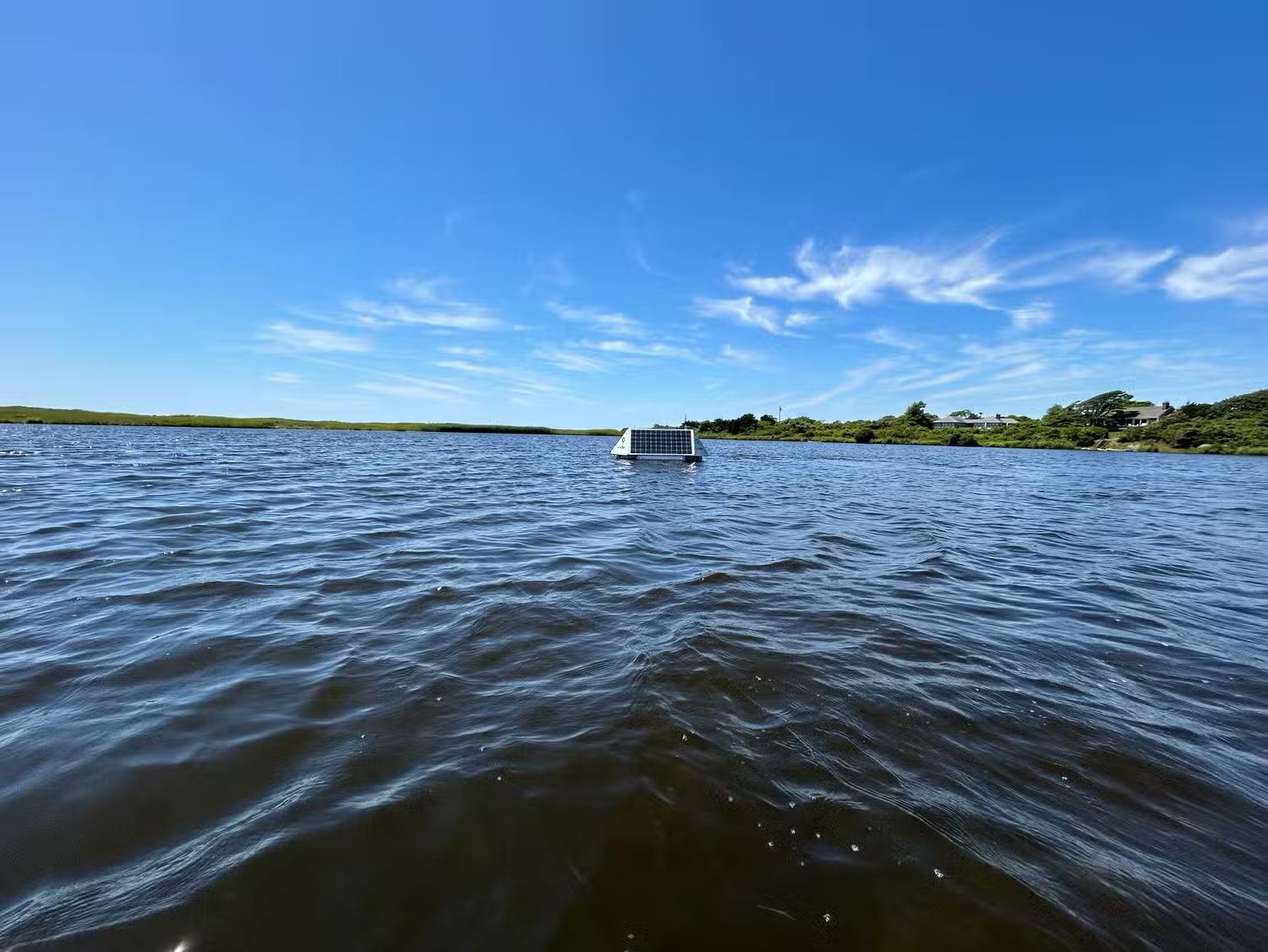
When the Chilmark Pond Foundation deployed an MPC-Buoy in July 2025, the goal was a measurable improvement in water quality. Independent monitoring by Great Pond Foundation through the 2025 season found evidence that the bloom dissipation rate was much faster with the buoy than previous seasons without it.

Credit: Chilmark Pond Foundation
Chilmark Pond Water Quality Data: Rapid Improvement
Great Pond Foundation researchers compared 2025 bloom dynamics against historical data from 2022-2024. The findings:
Bloom dissipation time: 8 days (2025 with MPC-Buoy) vs. 29 days (2022) and 15 days (2024) without ultrasonic intervention
Dissipation rate: 11.44 micrograms per liter per day vs. historical baseline of 2-3 micrograms per liter per day
“When the buoy was functioning properly, the cyanobacteria population dropped in five days,” Reddington explained during a February 2026 stakeholder presentation. “We’ve never seen that happen before.”
How Water Quality Monitoring Enabled Results
The MPC-Buoy’s dual functionality proved critical to Chilmark Pond water quality improvement. Every 30 minutes, the platform measured temperature, pH, dissolved oxygen, chlorophyll-a, and other parameters, transmitting data to the Great Pond Foundation. This enabled researchers to track bloom development in real-time rather than relying on weekly grab samples.
The ultrasonic component complemented monitoring with prevention: Chemical algaecides kill cyanobacteria cells, releasing intracellular contents, including any toxins the cells contain, into the water column. Ultrasound works differently: it interferes with the cells’ buoyancy regulation, and the cells remain intact. The difference matters most during an active bloom, when algaecide dosing can raise dissolved toxin levels at the moment a treatment plant is least able to absorb them.
“Instead of adding a chemical or disturbing the environment, it uses sonic pulses targeted specifically at cyanobacteria to keep them from growing out of control,” Reddington explained to WBZ News.
Community Impact
Amy Salzman, president of the Chilmark Pond Foundation, framed the water quality success in personal terms for CBS News: “When my kids were little, they kind of learned to swim in there. We came and rented for two weeks every summer. And I would love for the water quality of that part of the pond to be restored.”
Sharon Seagull, a longtime resident, told WBZ News: “My grandchildren used to swim in this pond. They can’t anymore. That reality shifted in 2025.”
Integrated Approach to Water Quality
Chilmark Pond water quality improvement resulted from a comprehensive strategy. Winter 2025 dredging removed approximately 6,000 cubic yards of accumulated sediment from the pond’s cut area. The March 2025 cut remained open for 33 days, the longest duration in over a decade, allowing sustained saltwater flushing that reduced nutrient concentrations.
“We need different levels of mitigation to help combat that density of humanity,” Reddington told WBZ News, acknowledging that ultrasonic control addresses bloom symptoms while dredging and nutrient management tackle root causes.
This integrated approach offers a replicable model for coastal waterbodies facing similar nutrient loading pressures from aging infrastructure. Physical restoration, nutrient exchange, and proactive bloom prevention working in concert delivered measurable Chilmark Pond water quality gains.
What Success Factors Drove Results
The improvement in Chilmark Pond water quality resulted from strategic deployment:
Pre-season positioning: The MPC-Buoy was deployed in July, ahead of peak bloom conditions
Strategic placement: Sited at the historical bloom epicenter with clear acoustic coverage across the pond
Continuous monitoring: Real-time data enabled adaptive management rather than reactive responses
Complementary interventions: Dredging and cutting supported long-term water quality goals beyond bloom control
For municipalities and lake districts facing recurring blooms, the record at Chilmark Pond is specific. Bloom dissipation took eight days in fall 2025, against 15 days in 2024 and 29 days in 2022, measured independently by Great Pond Foundation, whose own reading is that the data suggest the buoy probably worked. That same season included winter dredging and a cut that stayed open for 33 days, and CBS credits both for the pond’s condition. Nutrient loading from surrounding soils and aging septic systems is unchanged. What transfers to another waterbody is narrower than restoration: continuous measurement that shows a bloom forming, and treatment that can run alongside the nutrient work rather than waiting on it.
“Living waters are really the spirit and the character of Martha’s Vineyard,” Reddington told CBS. “To think about families being able to return for generations to come in a living ecosystem and experience that joy of interacting with the vitality of nature, that’s why I do my job.”
Looking Ahead: Sustained Water Quality
Chilmark Pond water quality monitoring continues into the 2026 season. The foundation plans to deploy the MPC-Buoy in May 2026, earlier than the July 2025 deployment, to maximize pre-bloom prevention. Ongoing collaboration between the Chilmark Pond Foundation and Great Pond Foundation ensures rigorous data collection for long-term water quality trend analysis.
For communities watching Chilmark Pond water quality recovery with interest, the message is clear: decades of nutrient loading do not lock waterbodies into permanent degradation. Strategic intervention, sustained monitoring, and community commitment.
Chilmark Pond achieved 3× faster bloom control. Other waterbodies facing similar challenges can achieve comparable results with the right approach.
Ready to Achieve Similar Results?
From drinking water reservoirs to recreational lakes, utilities and lake managers worldwide are achieving measurable water quality improvements with ultrasonic algae control and real-time monitoring.
If your waterbody faces recurring cyanobacteria blooms, seasonal treatment costs, or public health advisories, the solution is proven. Talk to an expert to assess MPC-Buoy suitability for your specific water quality challenges.
Read more:
MPC-Buoy Deployed in Chilmark Pond to Support Water Quality Restoration (July 2025)
External coverage:
CBS News Boston: A Martha’s Vineyard pond was threatened by toxic algae. Here’s how Chilmark saved it. (April 24, 2026)