

Short answer
The practical copper sulfate alternatives for drinking water reservoirs are chelated copper, hydrogen peroxide, phosphorus-binding products such as Phoslock, aeration, watershed nutrient management, and chemical-free ultrasonic algae control. Copper sulfate acts quickly, yet it can release cyanotoxins when it ruptures cyanobacteria cells, and it builds up in the sediment over time. For that reason, more utilities now prevent blooms at the source instead of treating them after they form. LG Sonic’s MPC-Buoy pairs continuous monitoring with chemical-free ultrasonic control to do this in a single platform.
Key points
- Copper sulfate is cheap, but it is toxic to fish and invertebrates and it accumulates in reservoir sediment.
- When copper ruptures cyanobacteria cells, it can release microcystin and other cyanotoxins, sometimes near the intake.
- Every chemical algaecide treats the symptom, so blooms return while nutrients remain and repeat dosing becomes routine.
- Ultrasonic algae control is chemical-free, and because it does not lyse cells, it releases no toxins.
- At American Water in New Jersey, the MPC-Buoy eliminated algaecide use and saved roughly $87,800 a year in operating costs.
- The strongest results come from pairing real-time monitoring with control, so operators can act before a bloom peaks.
Copper sulfate has controlled algae in drinking water reservoirs for more than a century. It is inexpensive, familiar, and it clears a visible bloom within days. However, the same traits that make it convenient also create problems that many utility managers now want to avoid. Because a chemical dose treats the symptom rather than the cause, the bloom usually returns once nutrients remain, so the treatment has to be repeated. This guide compares the practical copper sulfate alternatives for a drinking water source, weighs each trade-off honestly, and explains why a growing number of operators are shifting from reactive dosing toward prevention at the reservoir itself.
Why do water utilities still use copper sulfate?
Copper sulfate stays popular for three practical reasons. First, it is inexpensive and easy to source. Second, it acts fast, so a bloom can shrink within a day or two. Third, operators trust it, because reservoir managers have relied on it since the early 1900s. For a plant facing sudden taste-and-odor complaints, that speed feels reassuring.
Speed, however, is not the same as a solution. A rapid knockdown removes the visible symptom, yet the nutrients that fed the bloom stay in the water and the sediment. As a result, the algae tend to grow back, so the dose has to be repeated through the season. Over time, those repeat treatments add up in cost, labor, and compliance risk. In short, the chemistry that clears a bloom this week does little to stop the next one. That gap is exactly why utilities weigh copper sulfate alternatives.
What are the risks of copper sulfate in drinking water reservoirs?
Four risks matter most when the water is destined for the tap.
Toxin release from cyanobacteria
When copper ruptures a cyanobacteria cell, the cell spills its contents, including cyanotoxins such as microcystin. Consequently, a treatment that kills algae quickly can raise toxin levels for a short period, sometimes above the levels present during the active bloom. Near a drinking water intake, that is precisely the wrong result. Because the EPA tracks cyanotoxins closely for their health effects, prevention is generally preferable to a rapid chemical kill.
Toxicity to fish and other aquatic life
Copper is toxic to most aquatic species. According to the EPA, it binds to fish gill membranes and disrupts the way fish regulate salt and water. Sensitive species such as trout are especially at risk. Moreover, a fast algae die-off lowers dissolved oxygen as the dead cells decompose, which can stress or kill fish even when the copper dose itself is not lethal.
Accumulation in the sediment
Copper does not break down. Instead, it settles into the sediment and stays there as a heavy metal. Long-term studies of frequently treated lakes have documented sharply reduced bottom-dwelling life after decades of copper use. For a reservoir meant to serve generations, that is a lasting cost rather than a single-season expense.
Permitting and regulatory pressure
Applying an algaecide is regulated. Copper treatments often require a discharge permit, and some jurisdictions restrict copper in drinking water sources altogether. Therefore each application adds reporting, oversight, and compliance exposure that a chemical-free method avoids. Taken together, these four risks are what push many drinking water operators toward copper sulfate alternatives. For a fuller picture of these trade-offs, see our overview of the downsides of chemicals in water treatment.
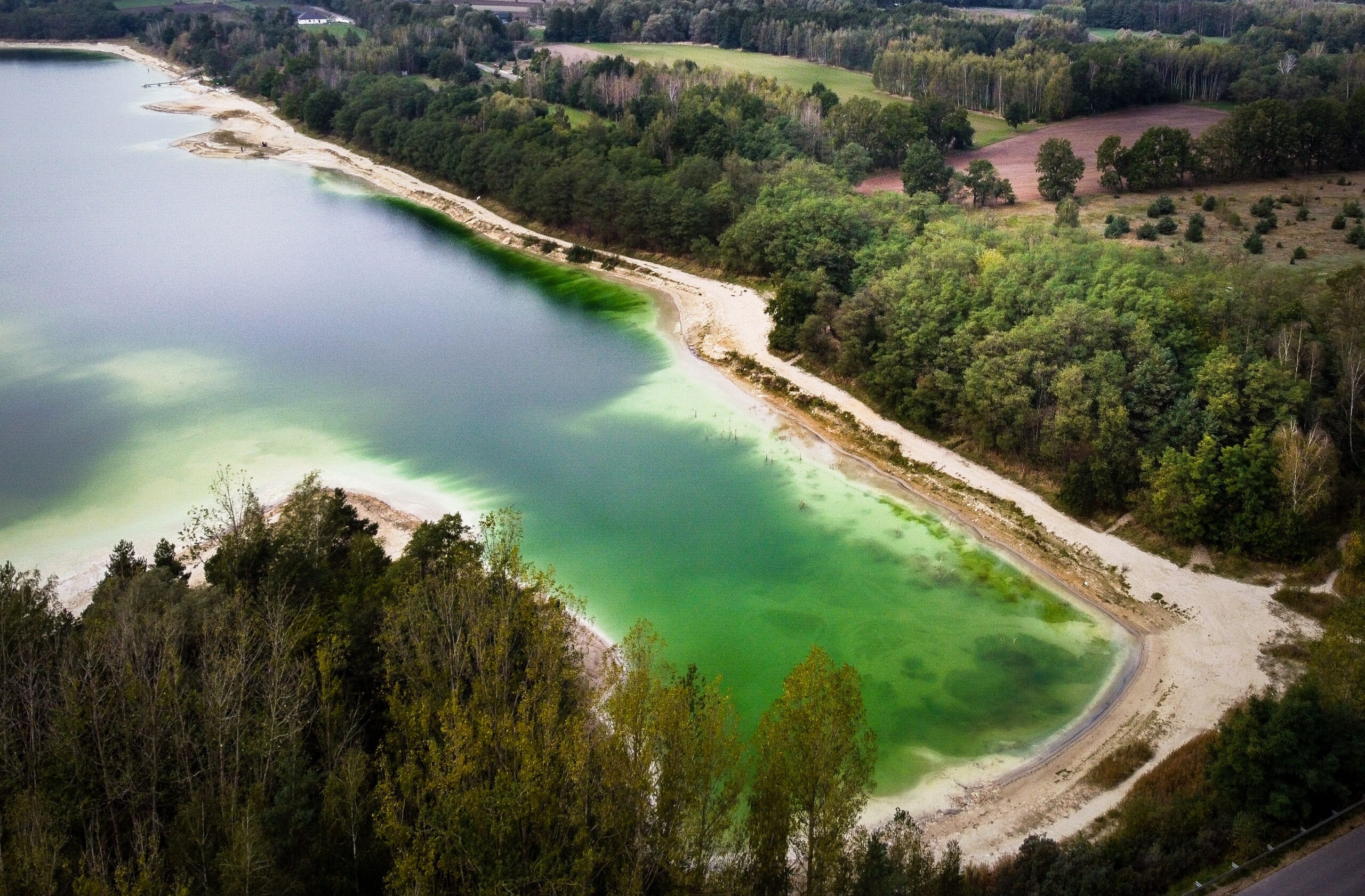
A visible algal bloom accumulating along the shoreline of an inland freshwater lake.
What are the main copper sulfate alternatives?
No single product replaces copper sulfate in every reservoir. Instead, utilities weigh several copper sulfate alternatives, and each strikes a different balance of speed, cost, safety, and durability. The table below sets the practical options side by side, with an honest look at the catch that matters for a drinking water source.
Comparison of copper sulfate alternatives at a glance
| Method | How it works | The catch for a drinking water reservoir |
|---|---|---|
| Chelated copper (copper ethanolamine, Cutrine-Plus) | A copper algaecide, released more slowly than copper sulfate but still copper. | It still accumulates in the sediment as a heavy metal, still needs a permit, and still ruptures cyanobacteria cells, releasing toxins near the intake. A slower release does not make copper sustainable. |
| Hydrogen peroxide | An oxidant that kills algae cells on contact, much as chlorine does. | Because it kills by rupturing cells, it can release the same toxins during die-off. It is also short-lived, so it needs repeat dosing and can stress fish and other non-target life. |
| Phosphorus binding (Phoslock, alum) | A chemical that binds phosphorus in the water and the sediment. | It addresses phosphorus only, its effect fades if nutrients keep arriving from the catchment, and repeated doses add material to the reservoir bed. |
| Aeration and mixing | Circulates water to break thermal stratification and raise dissolved oxygen. | It does not control algae by itself. Instead, it is a useful complement to a control method, not a treatment, and it carries an energy cost. |
| Watershed nutrient management | Reduces nutrient inputs across the catchment to starve future blooms. | It is the right long-term foundation, yet it works over years, needs broad cooperation, and cannot touch the phosphorus already in the sediment. |
| Ultrasonic algae control (MPC-Buoy) | Low-power ultrasound keeps algae below the surface so they cannot reach sunlight. It does not kill or rupture cells, so it releases no toxins and adds nothing to the water. | It works gradually over weeks rather than overnight, and it does not remove nutrients, so lasting recovery still pairs it with watershed management. |
How does ultrasonic algae control compare to copper sulfate?
For a drinking water reservoir, the main chemical-free alternative to copper sulfate is ultrasonic algae control. Utilities such as American Water have used LG Sonic’s MPC-Buoy to eliminate algaecide entirely.
The key difference is the mechanism. Copper sulfate kills algae, and so does an oxidant such as hydrogen peroxide. That fast kill is the problem, not the selling point, because rupturing the cells is exactly what releases the toxins they hold. Low-power ultrasound, by contrast, does not kill or rupture the cells. Instead, it changes the buoyancy of the algae so they sink below the sunlit surface layer, where they cannot photosynthesize or form a bloom. Since the cells stay intact, no toxins are released. Our page on how the ultrasound technology works explains the mechanism in more detail.
That single difference reshapes the risk profile for a drinking water source. There is no toxin spike at the intake, no copper added to the sediment, and no algaecide to permit or report. In addition, the ultrasound is safe for fish, aquatic plants, people, and zooplankton, which an independent study for a Dutch water board confirmed. You can compare approaches on our ultrasonic algae control page. Among the copper sulfate alternatives, ultrasonic control removes the toxin risk instead of managing it.
Timing also differs. A chemical knocks a bloom down in days, whereas ultrasound works gradually over several weeks as it limits new bloom formation. For that reason it is best started before peak season and run as a continuous program rather than a one-time fix. In exchange, the utility avoids the closures, permits, and toxin spikes that come with reactive dosing.
Where ultrasound fits, and where it does not
Ultrasound is not a cure for eutrophication. It does not strip phosphorus or nitrogen from the water, so lasting recovery still depends on managing nutrients across the watershed. Results also vary with reservoir shape, algae species, and how the units are placed and tuned. LG Sonic manages this by monitoring each water body continuously and adjusting the ultrasonic program before the algae adapt. In practice, the strongest results combine monitoring, ultrasonic control, and source nutrient management, rather than any one method alone.
Field results
Utilities that replaced copper sulfate
Each of these drinking water utilities replaced copper sulfate with LG Sonic’s MPC-Buoy.
- American Water, New Jersey. The raw water reservoir had been dosed with copper sulfate and Cutrine-Plus. After MPC-Buoys were deployed, the utility eliminated algaecide use entirely and recorded roughly $87,800 in annual operating savings. The project won a Business Achievement Award from the Environmental Business Journal.
- Municipal drinking water plant, USA. Copper sulfate and potassium permanganate had failed to keep persistent algae in check. Once the MPC-Buoy was deployed, filter run time roughly tripled and influent turbidity fell sharply.
- Valdesia reservoir, Dominican Republic. Continuous monitoring paired with ultrasonic control produced an 87% reduction in chlorophyll-a.
- Berthoud, Colorado. Source water algae improved after the utility moved to a chemical-free approach.
Which copper sulfate alternative is right for your reservoir?
The right choice depends on your conditions, and a few questions usually point the way. No copper sulfate alternatives fit every reservoir, so match the method to the site.
- Are cyanobacteria present? If blue-green algae or toxins are a concern, avoid fast-acting copper on an active bloom, since cell rupture can release toxins near the intake. A non-lysing method is safer.
- How close is treatment to the intake? The nearer the intake, the more a toxin spike matters, and the more prevention beats reaction.
- What does your permit allow? Where copper is restricted or heavily permitted, a chemical-free option removes that burden.
- Do you need season-long protection? A single chemical dose suits an emergency, whereas an ongoing program suits year-round protection.
- How large is the reservoir? Chemicals grow costly and hard to spread evenly across large surfaces, while continuous ultrasonic coverage scales more predictably.
For most drinking water reservoirs, the durable answer is not a different chemical. Rather, it is a shift from treating blooms to preventing them, with real-time monitoring to catch problems early and ultrasonic control to stop algae from forming a bloom in the first place. Our guide to source water protection brings these pieces together into one strategy, and the drinking water reservoirs page shows how the approach is applied in practice.
Frequently asked questions
What can I use instead of copper sulfate to control algae?
The practical copper sulfate alternatives are chelated copper, hydrogen peroxide, phosphorus-binding products, aeration, watershed nutrient management, and chemical-free ultrasonic algae control. For a drinking water source, ultrasonic control adds no chemicals and releases no toxins, so utilities such as American Water use LG Sonic’s MPC-Buoy in place of copper sulfate.
Is copper sulfate banned in drinking water reservoirs?
Not everywhere. Copper sulfate is still permitted in many places, yet its use is regulated, often requires a discharge permit, and some jurisdictions restrict copper in drinking water sources. Because rules vary by country and state, check with your regulator before applying.
Does copper sulfate release toxins?
It can. When copper sulfate ruptures cyanobacteria cells, those cells release stored cyanotoxins such as microcystin into the water. As a result, treating an active blue-green bloom with copper can temporarily raise toxin levels, which is a particular concern near a drinking water intake.
What is the safest algae control method for a drinking water reservoir?
There is no single answer, but prevention is safer than reactive killing. For example, continuous monitoring paired with chemical-free ultrasonic control avoids toxin spikes, adds no copper to the sediment, and needs no algaecide permit. In addition, nutrient management at the source supports lasting results.
Does ultrasonic algae control work on cyanobacteria?
Yes, because it targets the buoyancy that cyanobacteria rely on to reach sunlight. Independent field results vary by site and species, so performance depends on correct unit placement and program tuning. Since it works gradually, it is most effective when started before a bloom peaks.
Is ultrasound safe for fish and drinking water?
Low-power ultrasound used for algae control is safe for fish, aquatic plants, people, and zooplankton, and it adds nothing to the water. In fact, a study for a Dutch water board found no negative effects on zooplankton.
How quickly does each option work?
Chemicals such as copper sulfate and hydrogen peroxide act within days, but they wear off. Ultrasound, by contrast, works over weeks and keeps working as an ongoing program. Nutrient management is the slowest, although it is the most durable of the copper sulfate alternatives.
|
See how the MPC-Buoy fits your reservoir LG Sonic combines real-time monitoring with chemical-free ultrasonic algae control in a single solar-powered platform, deployed in more than 60 countries. Find out whether it suits your water body and how it compares to your current chemical program.
|